Philip Campagne and Inner Currents
Within this new virtual exhibition 'Inner Currents', the work of Philip Campagne unfolds as a visual exploration of the forces that shape our inner world. His paintings do not describe external reality, but give form to what moves beneath it — tension, control, conflict and the possibility of transformation.
The exhibition is structured around a series of interconnected themes — Power & Control, Conflict, Transformation and Final Reflection. Rather than functioning as separate chapters, these stages flow into one another, reflecting the continuous and often complex nature of inner processes. Each work marks a moment within that movement, capturing a state that is never entirely fixed.
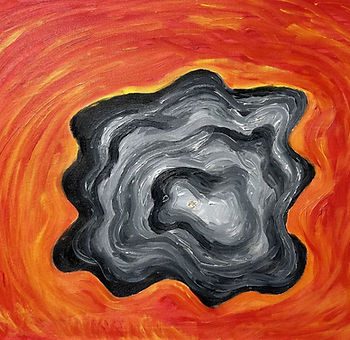
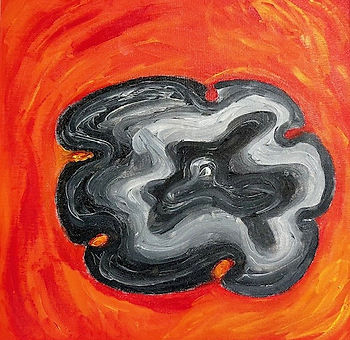
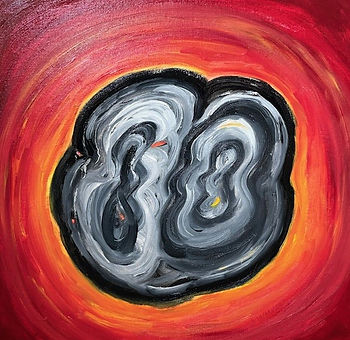
Philip'ss visual language is defined by organic, almost cellular forms that seem to emerge from within fields of intense colour. These shapes suggest something alive — expanding, contracting, resisting or opening. They can be read as inner landscapes, where emotional and psychological dynamics take on a tangible presence.
Titles play an important role in guiding the viewer’s experience. References to power, morality and human behaviour introduce a layer of reflection, without prescribing meaning. They act as entry points into the work, inviting the viewer to consider their own position within these themes.
In this virtual exhibition 'Inner Currents', looking becomes a form of introspection. The paintings do not offer answers, but create a space in which awareness can unfold — where the viewer is invited to recognise the subtle, often unseen movements within themselves.
About Philip Campagne
Philip Campagne’s work explores the inner forces that shape human experience. Rather than depicting the external world, his paintings give form to what is felt but not easily seen — tension, control, conflict and transformation.
His compositions are built from organic, almost cellular forms that seem to emerge from within luminous fields of colour. These shapes do not represent fixed images, but suggest states of being: moments of pressure, growth, resistance or release. They appear to hover between structure and fluidity, as if caught in a continuous process of becoming. Through this approach, Campagne shifts the focus from observation to introspection.
Colour plays a central role in his work. Deep reds, intense blues and radiant yellows function as emotional carriers, creating a sense of movement and energy within each piece. Rather than supporting the image, colour actively shapes its presence — at times concentrated and dense, at others open and expansive. The paintings seem to breathe, balancing between control and surrender, intensity and stillness.
Working primarily in oil on canvas, Philip embraces a process of layering and reworking. This allows time for the image to evolve, to shift and to reveal itself gradually. Each painting becomes a field of exploration in which intuition and decision continuously interact. What emerges is not a fixed outcome, but a moment within an ongoing process. Philip Campagne approaches painting as a process rather than a result. His work does not aim to provide clear narratives or definitive meanings, but instead opens a space for reflection. The viewer is invited to slow down, to look beyond the surface, and to engage with the work on a more intuitive level.
In this way, his paintings function as mirrors of inner experience — not illustrating it, but making it tangible. What remains is an open encounter, in which meaning is not imposed, but discovered.

Works from Inner Currents
by Philip Campagne
This overview brings together all works from Inner Currents, offering a complete view of the exhibition beyond the spatial experience of the 3D environment.
Each painting forms part of a larger visual journey, moving through themes of power, conflict, transformation and reflection. While presented here as individual works, they remain connected — fragments of an ongoing process in which inner dynamics take shape through colour, form and movement.
The works can be viewed independently, yet reveal additional layers when seen in relation to one another. Together, they create a field of tension and resonance, inviting a slower, more attentive way of looking.
Featured by CaroArtVirtualGallery